

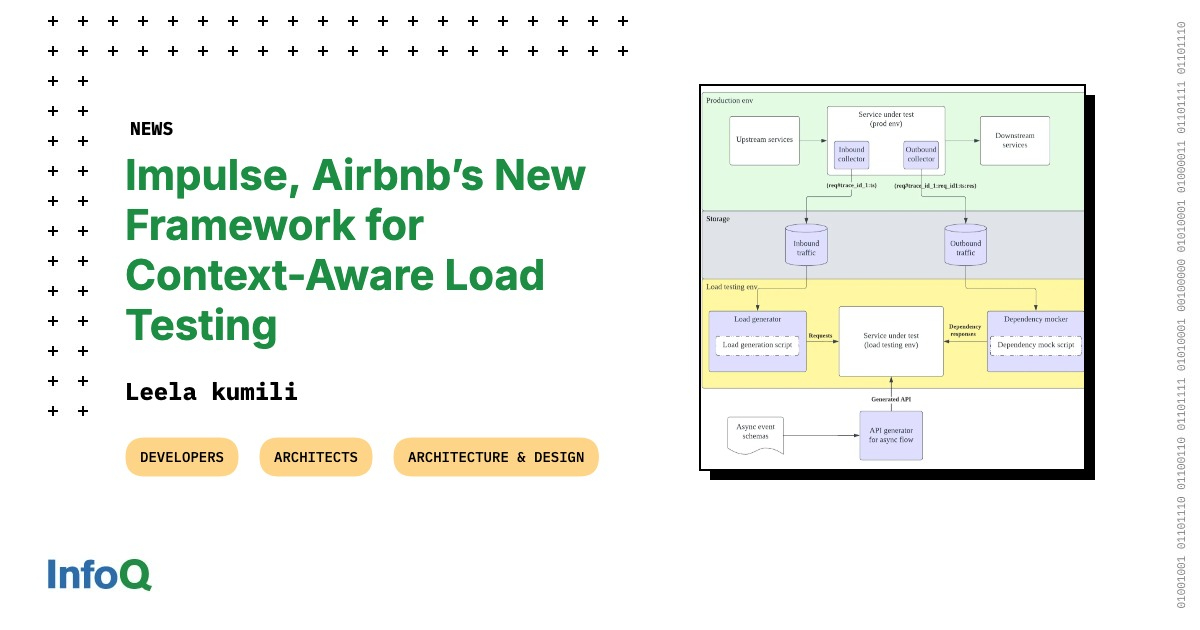
Airbnb, the renowned hospitality marketplace, continues to push boundaries in technology with its latest innovation – Impulse. This cutting-edge framework is poised to revolutionize the landscape of context-aware load testing for microservices. With Impulse, Airbnb engineers have a powerful tool at their disposal to enhance the reliability and performance of their microservices.
One of the standout features of Impulse is its ability to facilitate distributed, large-scale testing. This capability is crucial in today’s complex technological ecosystem where microservices play a pivotal role. By allowing teams to conduct self-service, context-aware load tests that seamlessly integrate with Continuous Integration (CI) pipelines, Impulse streamlines the testing process, making it more efficient and effective.
The importance of simulating production-like traffic cannot be overstated in the realm of software development. Here is where Impulse truly shines. By mimicking real-world scenarios, engineers can proactively identify bottlenecks and potential errors, enabling them to address these issues before they have a chance to impact the end-users. This proactive approach not only enhances the overall user experience but also saves valuable time and resources by preventing issues from reaching the production environment.
In practical terms, Impulse empowers development teams to make informed decisions based on concrete data derived from comprehensive load testing. This data-driven approach is instrumental in optimizing the performance of microservices, ensuring that they meet the highest standards of reliability and efficiency. By leveraging Impulse, engineers can iterate rapidly, fine-tune their services, and deliver exceptional user experiences consistently.
The seamless integration of Impulse with CI pipelines further underscores its value in the software development lifecycle. By automating the testing process and making it an integral part of the development workflow, Impulse fosters a culture of continuous improvement and quality assurance. This integration not only saves time but also instills confidence in the development process, knowing that each code change is rigorously tested before deployment.
In conclusion, Airbnb’s Impulse framework represents a significant leap forward in the realm of context-aware load testing for microservices. Its ability to enable distributed, large-scale testing, integrate seamlessly with CI pipelines, and simulate production-like traffic sets a new standard for performance testing in the industry. By empowering engineers to identify and address issues proactively, Impulse paves the way for more reliable, efficient, and user-centric microservices. As technology continues to advance, tools like Impulse will play a crucial role in shaping the future of software development.