Tag: Context-aware Testing

  • Impulse, Airbnb’s New Framework for Context-Aware Load Testing

    Enhancing Microservice Reliability with Impulse: Airbnb’s Innovative Load Testing Framework

    In the dynamic landscape of microservice architectures, ensuring reliability and performance is paramount. Airbnb, a trailblazer in the tech industry, has unveiled Impulse—a cutting-edge internal load testing framework designed to elevate microservice testing to new heights. This innovative tool empowers development teams to conduct distributed, context-aware load tests seamlessly integrated into their CI pipelines, revolutionizing the way engineers validate system performance.

    Traditionally, load testing has been a cumbersome and time-consuming process, often failing to mirror real-world scenarios adequately. With Impulse, Airbnb has tackled this challenge head-on by enabling teams to simulate production-like traffic effortlessly. By replicating actual user interactions at scale, engineers gain invaluable insights into system behavior, identifying potential bottlenecks and errors early in the development lifecycle.

    One of the standout features of Impulse is its self-service nature, allowing teams to initiate load tests autonomously. This self-serve capability streamlines the testing process, fostering agility and efficiency within development cycles. By integrating seamlessly with CI pipelines, Impulse ensures that performance testing becomes an integral part of the development workflow, rather than an afterthought.

    The significance of context-aware load testing cannot be overstated. By tailoring tests to reflect specific use cases and traffic patterns, engineers can uncover hidden vulnerabilities and optimize system performance proactively. This proactive approach minimizes the likelihood of performance issues slipping through the cracks and surfacing in production—a scenario that every developer aims to avoid.

    Moreover, Impulse’s ability to facilitate large-scale, distributed testing sets it apart from traditional load testing tools. In today’s interconnected world where microservices interact across complex architectures, the need for comprehensive testing that mirrors real-world conditions is more critical than ever. Airbnb’s Impulse rises to this challenge, empowering teams to validate system performance under diverse and demanding scenarios.

    In conclusion, Impulse represents a significant leap forward in the realm of microservice load testing. By leveraging this innovative framework, development teams can enhance system reliability, preemptively address performance bottlenecks, and elevate the overall quality of their microservices. As Airbnb continues to push the boundaries of technology with tools like Impulse, the industry at large stands to benefit from enhanced testing practices that pave the way for more robust and resilient microservice architectures.
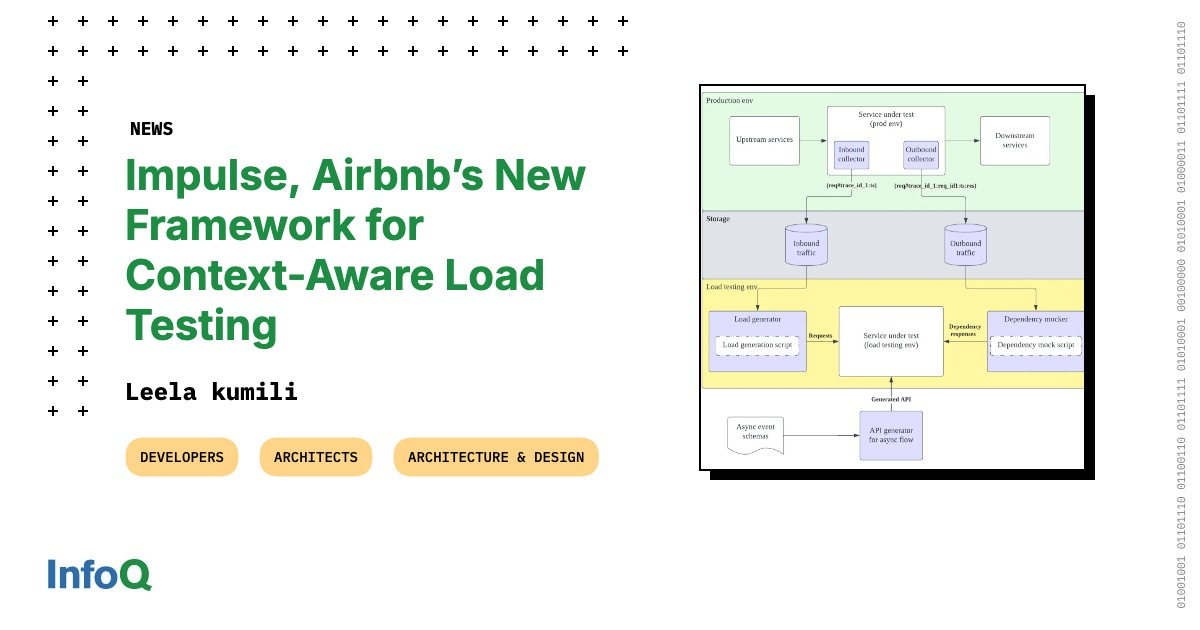
  • Impulse, Airbnb’s New Framework for Context-Aware Load Testing

    !Airbnb Impulse

    Airbnb, the renowned hospitality marketplace, continues to push boundaries in technology with its latest innovation – Impulse. This cutting-edge framework is poised to revolutionize the landscape of context-aware load testing for microservices. With Impulse, Airbnb engineers have a powerful tool at their disposal to enhance the reliability and performance of their microservices.

    One of the standout features of Impulse is its ability to facilitate distributed, large-scale testing. This capability is crucial in today’s complex technological ecosystem where microservices play a pivotal role. By allowing teams to conduct self-service, context-aware load tests that seamlessly integrate with Continuous Integration (CI) pipelines, Impulse streamlines the testing process, making it more efficient and effective.

    The importance of simulating production-like traffic cannot be overstated in the realm of software development. Here is where Impulse truly shines. By mimicking real-world scenarios, engineers can proactively identify bottlenecks and potential errors, enabling them to address these issues before they have a chance to impact the end-users. This proactive approach not only enhances the overall user experience but also saves valuable time and resources by preventing issues from reaching the production environment.

    In practical terms, Impulse empowers development teams to make informed decisions based on concrete data derived from comprehensive load testing. This data-driven approach is instrumental in optimizing the performance of microservices, ensuring that they meet the highest standards of reliability and efficiency. By leveraging Impulse, engineers can iterate rapidly, fine-tune their services, and deliver exceptional user experiences consistently.

    The seamless integration of Impulse with CI pipelines further underscores its value in the software development lifecycle. By automating the testing process and making it an integral part of the development workflow, Impulse fosters a culture of continuous improvement and quality assurance. This integration not only saves time but also instills confidence in the development process, knowing that each code change is rigorously tested before deployment.

    In conclusion, Airbnb’s Impulse framework represents a significant leap forward in the realm of context-aware load testing for microservices. Its ability to enable distributed, large-scale testing, integrate seamlessly with CI pipelines, and simulate production-like traffic sets a new standard for performance testing in the industry. By empowering engineers to identify and address issues proactively, Impulse paves the way for more reliable, efficient, and user-centric microservices. As technology continues to advance, tools like Impulse will play a crucial role in shaping the future of software development.

  • Modern Test Automation With AI (LLM) and Playwright MCP

    In the fast-paced world of software development, delivering high-quality applications at scale is a constant challenge. Traditional test automation has long been a staple in the industry, offering powerful tools to enhance efficiency and accuracy. However, even with these tools, challenges such as dealing with dynamic user interfaces, flaky tests, and time-consuming script maintenance persist.

    Enter the realm of modern test automation, where cutting-edge technologies like generative AI (GenAI) and Playwright MCP (Model Context Protocol) are revolutionizing the way QA processes are streamlined. By harnessing the power of AI and combining it with the innovative approach of Playwright MCP, testers can now navigate through complex testing scenarios with ease and precision.

    GenAI, with its ability to generate test scripts autonomously based on application behavior, brings a new level of intelligence to test automation. This means that instead of manually creating and maintaining test scripts for each scenario, testers can rely on AI to adapt and evolve alongside the application under test. As a result, testing becomes more robust, efficient, and adaptive to changes, ultimately leading to higher quality applications.

    On the other hand, Playwright MCP complements GenAI by providing a standardized protocol for capturing and representing the context of a test scenario. This context-aware approach enables testers to interact with applications in a more dynamic and realistic manner, mimicking user behavior accurately. By leveraging Playwright MCP, testers can create resilient and maintainable test scripts that are less prone to failures and easier to update as the application evolves.

    Together, GenAI and Playwright MCP form a powerful duo that not only accelerates the testing process but also empowers testers to focus on more strategic tasks. By automating repetitive and time-consuming testing activities, testers can allocate their time and expertise to areas that require human intervention, such as exploratory testing, identifying edge cases, and analyzing test results for deeper insights.

    Furthermore, the combination of AI-driven test automation and context-aware testing not only improves the efficiency of QA processes but also enhances the overall quality of applications. By catching bugs early in the development cycle, ensuring consistent test coverage, and reducing the risk of regression issues, teams can deliver reliable and user-friendly applications with confidence.

    In conclusion, the integration of generative AI and Playwright MCP represents a significant advancement in modern test automation, offering a transformative approach to QA processes. By harnessing the power of AI to automate test script generation and leveraging context-aware testing capabilities, organizations can achieve greater efficiency, accuracy, and agility in their testing efforts. Embracing these technologies is not just about keeping up with the latest trends—it’s about staying ahead of the curve and delivering exceptional software products that meet the demands of today’s competitive market.