
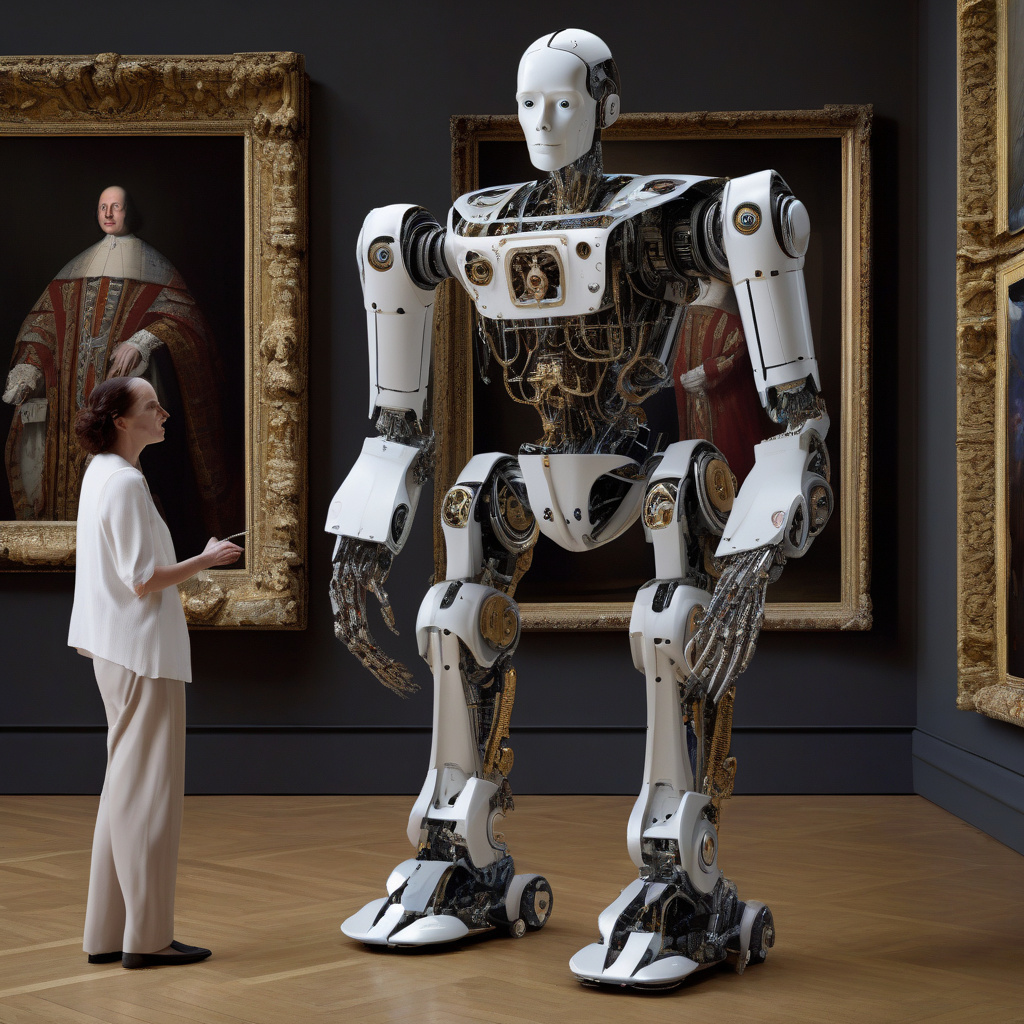
Robot artist Ai-Da, the groundbreaking ultra-realistic creation, has once again captured the spotlight with a significant artistic feat – painting a portrait of His Majesty King Charles III. This achievement marks a pivotal moment in the intersection of art and technology, raising intriguing questions about the capabilities and limitations of AI-driven creativity.
The unveiling of this portrait sparks a compelling debate within the art community and beyond: is the artwork any good? Assessing the quality of Ai-Da’s creation involves a nuanced consideration of various factors. While traditional artistic standards such as technique, composition, and expression still hold relevance, evaluating a robot artist introduces a new dimension to the critique.
Ai-Da’s portrait of King Charles III invites us to ponder the essence of artistry itself. Can a machine evoke emotion, capture essence, or convey meaning in the same way as a human artist? While Ai-Da’s precision and attention to detail are commendable, some may argue that true artistic brilliance stems from human experience, emotion, and creativity that AI, no matter how advanced, cannot replicate.
On the other hand, supporters of Ai-Da’s work highlight the fusion of technology and art as a gateway to innovative possibilities. The robot artist’s ability to analyze data, interpret aesthetics, and create visually appealing pieces challenges conventional notions of creativity. In this light, Ai-Da’s portrait of King Charles III serves as a testament to the evolving landscape of art in the digital age.
Critics may question the authenticity and soul of art produced by a machine, emphasizing the intrinsic value of human touch and imperfections in the creative process. However, proponents of AI-generated art argue that innovation knows no bounds, and the collaboration between human ingenuity and artificial intelligence can lead to groundbreaking artistic expressions that transcend conventional norms.
Ultimately, the question of whether Ai-Da’s portrait of King Charles III is “good” remains subjective, intertwining personal perspectives, artistic principles, and technological advancements. As we navigate this uncharted territory where robots wield paintbrushes and pixels, it’s essential to appreciate the diversity of artistic expression while contemplating the profound implications of AI’s role in shaping the future of creativity.
In conclusion, Ai-Da’s unveiling of the portrait of King Charles III sparks a thought-provoking dialogue on the intersection of art, technology, and creativity. Whether we deem the artwork “good” or not, the significance of this milestone lies in its ability to challenge our perceptions, broaden our horizons, and redefine the boundaries of artistic innovation in an ever-evolving digital landscape.
As we witness the evolution of AI-driven artistry, let us embrace the complexity, diversity, and endless possibilities that arise when human imagination and artificial intelligence converge in the realm of creativity.