
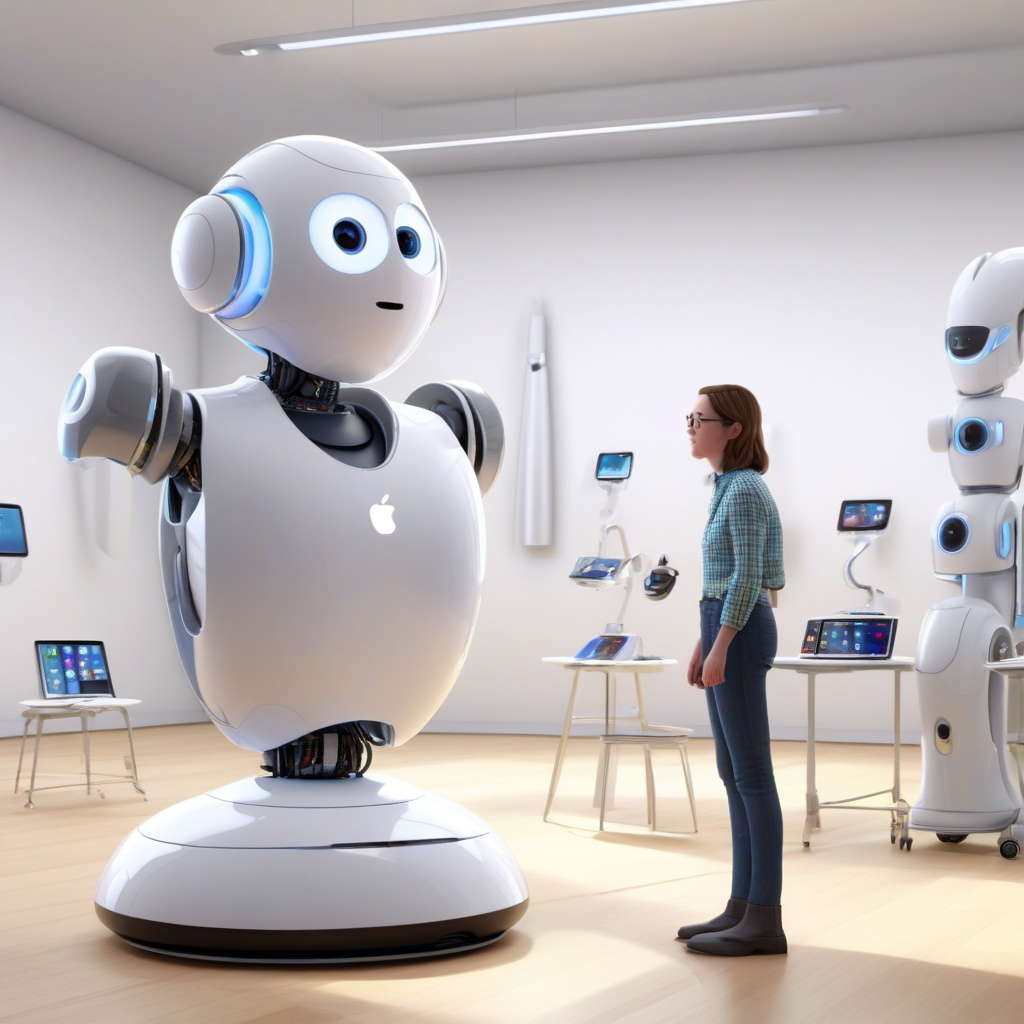
Apple’s foray into the realm of consumer robotics is gaining attention with its latest research efforts drawing inspiration from an unexpected source – Pixar. In a recent research paper, Apple delves into the nuances of human-robot interaction, emphasizing the importance of expressive movements in creating engaging experiences.
The key takeaway from Apple’s research paper is the notion that humans, much like animals, are deeply attuned to motion and subtle changes in movement. By acknowledging this fundamental aspect of human behavior, Apple aims to enhance the interactions users have with its robotic technologies, paving the way for more intuitive and seamless experiences.
Drawing parallels to Pixar, a renowned animation studio celebrated for its ability to infuse life and emotion into digital characters, Apple underscores the significance of imbuing robots with expressive movements. Just as animated characters captivate audiences through their lifelike gestures and movements, robots equipped with similar capabilities can forge stronger connections with users, fostering a sense of familiarity and comfort.
By taking a page from Pixar’s playbook, Apple showcases its commitment to pushing the boundaries of consumer robotics beyond mere functionality. Through a nuanced understanding of human psychology and behavior, Apple endeavors to humanize robots, transforming them from mere machines into interactive companions capable of eliciting genuine emotional responses from users.
This approach not only aligns with Apple’s reputation for innovation and user-centric design but also signals a shift towards more emotionally resonant technologies in the realm of robotics. As the boundaries between humans and machines continue to blur, the ability to imbue robots with expressive movements represents a significant step towards creating more empathetic and relatable robotic companions.
In a world where technology plays an increasingly pervasive role in our daily lives, the integration of expressive movements in robotics holds the promise of enriching human-robot interactions on a profound level. By leveraging insights from fields as diverse as animation and psychology, Apple is poised to redefine the way we perceive and engage with robotic technologies, setting a new standard for innovation in the realm of consumer robotics.
As Apple’s research endeavors continue to evolve, fueled by a deep understanding of human behavior and a commitment to pushing the boundaries of technological possibility, the prospect of robots that not only serve utilitarian functions but also forge emotional connections with users becomes increasingly tangible. With each new development, Apple’s research robot inches closer to realizing the vision of a future where human-robot interaction is not just seamless but truly transformative.
In conclusion, Apple’s exploration of expressive movements in consumer robotics, inspired by the creative ingenuity of Pixar, underscores the company’s dedication to redefining the boundaries of human-robot interaction. By infusing robots with lifelike gestures and movements, Apple is not just advancing the field of robotics but also shaping a future where technology transcends functionality to evoke genuine emotional responses from users.